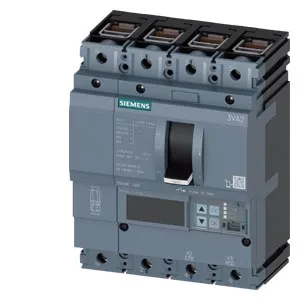
What this MCCB carries and where it fits
The Siemens 3VA2125-7HM32-0LK0 is an IEC frame 160 molded-case circuit breaker with a breaking capacity class C rating of Icu=110kA at 415 V AC — that is the maximum short-circuit current it can safely interrupt at that voltage without welding its contacts or rupturing the arc chamber. For a 25 A frame, 110 kA is high-end interrupting capacity, which means it can sit upstream of a distribution board fed from a large transformer without needing a current-limiting fuse ahead of it. The electronic trip unit is an ETU330 with LIG protection: long-time (L) adjustable overload from Ir=10 A up to 25 A, short-time/short-circuit (I) adjustable from 1.5 to 12 x In, and ground-fault (G) protection adjustable from 0.6 to 1 x In with a time delay tg of 0.1 or 0.3 seconds. That makes it suitable for a feeder or main breaker in a panel where you need selective coordination downstream — the ground-fault element catches arcing faults to earth without nuisance-tripping branch breakers. It ships with a nut keeper kit and a universal release (UNI) for 24 V DC shunt trip, plus a single auxiliary switch HQ, a trip alarm switch HQ, and an electrical alarm switch — all factory-fitted. That means the panel builder does not need to order separate accessory kits for remote status indication or emergency trip; the switching contacts are already wired to terminals on the breaker.
Integration into a panel
The 3VA2 frame 160 mounts on a standard DIN rail or can be screw-mounted to a backplate. The 3-pole footprint with the ETU330 and auxiliary switches occupies roughly the same width as a standard MCCB of this frame size — check the drilling plan if you are retrofitting into an existing gland plate or busbar system. The universal release (UNI) draws its 24 V DC from a control transformer or UPS; verify the coil inrush current against your power supply rating.
What the ratings mean for selectivity
The Icu=110 kA at 415 V is the ultimate breaking capacity per IEC 60947-2 — the breaker can interrupt that fault current once and still be functional (though it should be inspected afterward). For selective coordination with downstream breakers, the ETU330's short-time pickup and delay (I and G) let you set a time band that holds the main closed while a branch breaker clears a lower-level fault. The 0.1 s or 0.3 s ground-fault delay is enough to ride through a transformer inrush or a downstream GFCI trip.
