That flat thermal curve means the 25 A rating holds in a hot enclosure; you don't lose headroom as the panel warms up. Ground-fault monitoring uses summation-current sensing on L+N conductors, so it detects leakage without a separate GFCI module — one less device on the DIN rail.
Interrupting capacity — the real selectivity number
The interrupting rating is 330 kA at 240 V, dropping to 242 kA at 415 V and 440 V, 187 kA at 500 V, and 3.7 kA at 690 V. At 690 V the rating drops sharply to 3.7 kA, so this is not a 690 V main breaker; it belongs on a 480 V or lower bus. The adjustable thermal-magnetic trip range spans 38 A minimum to 300 A maximum — note that the 25 A continuous rating is the frame's maximum continuous current; the trip unit itself can be set lower for cable protection. Power loss is 0.6 W maximum, negligible for thermal budget in a dense panel.
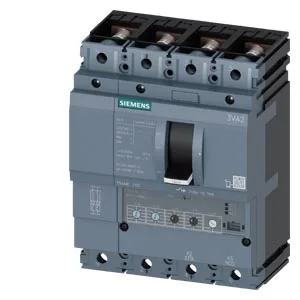
The 140 mm width is the same as other 4-pole 3VA2 breakers in this frame size, so swapping from a 3VA2025-8HM42-0AA0 or 3VA2125-8KQ42-0AA0 requires no re-drilling or bus-bar rework. No communication function and no undervoltage release — this is a straight thermal-magnetic breaker, no electronics to fail. Trip indicator is absent, so fault status must be read from the handle position. The 25 A continuous rating at 70 °C means it can be packed into a warm panel without derating, which simplifies the fill-factor calculation for the enclosure.