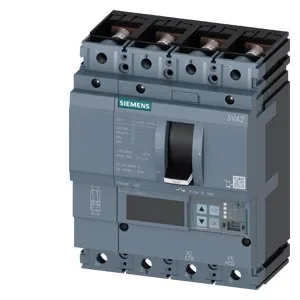
Its communication function and integrated ground-fault monitoring (summation current formation L+N) make it a smart breaker for modern distribution panels — you get fault visibility without a separate GFCI module.
Breaking capacity — what the ratings mean
This breaker delivers 330 kA at 240 V, 242 kA at 415 V, and 187 kA at 500 V — numbers that place it in the high-interrupting class. At 690 V the rating drops to 3.7 kA, which is typical for a 4-pole device operating near its insulation limit (rated 800 V). For a 25 A frame, these are high-fault ratings; you can mount this breaker downstream of a large transformer or service entrance without worrying about cascading failure.
The continuous current rating is 25 A, and the full-scale value matches that. Trip setting adjustable from 38 A minimum up to 300 A maximum — wide range gives you flexibility to match cable or load. Power loss is 0.6 W max, negligible for panel heat budget.
No undervoltage release and no trip indicator on this variant; the communication port handles remote status.