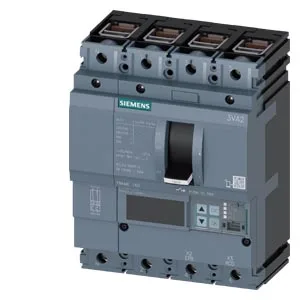
The Siemens SENTRON 3VA2125-7JQ46-0AA0 is a 4-pole molded case circuit breaker rated for 25 A continuous current, with a maximum frame rating of 300 A and a minimum setting of 38 A — sized for line protection on a 25 A feeder or branch circuit where the load won't exceed that continuous figure, provided the ambient stays within the -25 °C to 70 °C operating range. Its interrupting capacity is what holds the unit on the grid: 330 kA at 240 V, 242 kA at 415 V and 440 V, 187 kA at 500 V, and 3.7 kA at 690 V — the steep drop at 690 V tells you this breaker is designed for low-voltage distribution up to 500 V, and the 690 V figure is a residual capability for the rare 600 V class installation.
Physical integration
The 3VA2125-7JQ46-0AA0 measures 140 mm wide, 181 mm high, and 86 mm deep — a 4-pole MCCB in the SENTRON 3VA frame that mounts on a DIN rail or directly to a backplate via the integral mounting feet. At 86 mm depth it leaves clearance behind a standard 200 mm deep enclosure door; the 140 mm width occupies roughly 5.5 inches of DIN rail, which matters when you're counting fill factor on a crowded gland plate.
Selectivity and coordination
Rated insulation voltage is 800 V, so the breaker's internal creepage and clearance are designed for 690 V phase-to-phase systems with margin — the 3.7 kA interrupting capacity at 690 V is the practical limit for that voltage class.