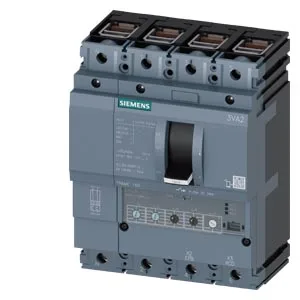
The ground-fault monitoring uses summation current formation on L+N conductors, so it detects residual current by comparing line and neutral — common in TN or TT systems where you want earth-fault detection without a separate RCD module.
Breaking capacity and where it fits
At 240 V it interrupts 440 kA; at 415/440 V that drops to 330 kA; at 690 V it's still 52.5 kA. Those are very high interrupting ratings for a 25 A frame — it's sized for high-fault installations like large transformer secondaries or industrial switchboards where available fault current exceeds 100 kA. The 4-pole format suits three-phase systems with a switched neutral, common in European and Asian distribution panels. Panel builders will find it occupies roughly the same DIN-rail or screw-mount space as other 160 A frame breakers, despite being a 25 A unit.
Thermal performance and derating
That's unusual for a thermal-magnetic breaker and means it can be packed into a warm enclosure without oversizing. Maximum power loss is 0.5 W — negligible for enclosure heat budget.