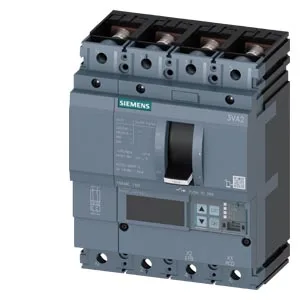
The 3VA2125-8KP42-0AA0: The breaking capacity is rated at 440 kA at 240 V AC, 330 kA at 415 V and 440 V, 220 kA at 500 V, and 52.5 kA at 690 V. That headroom means this breaker can sit at the main or sub-main position in a high-fault installation without cascading upstream — the SCCR is the rating that governs the bus bracing and arc-flash boundary, not the 25 A load rating. Physical footprint is 140 mm wide, 181 mm high, and 86 mm deep — standard for a 4-pole 3VA2 frame, so it drops into existing SENTRON switchboard layouts without re-drilling the mounting plate.
Trip unit and communication
The breaker does not include a ground-fault monitoring version, an undervoltage release, or a voltage trigger — those are separate accessories that plug into the 3VA2 accessory slots. If the BOM calls for shunt trip or UVR, order the add-on module alongside this frame.
Thermal profile and operating range
That is unusual for a thermal-magnetic breaker; the electronic trip compensates electronically, so the 25 A rating is the same at 40 °C and 70 °C. For a furnace controls engineer, this means the breaker does not nuisance-trip when the panel sits near a hot process zone, as long as the ambient stays under 70 °C. Maximum power loss is 0.5 W, negligible for panel thermal budgeting.