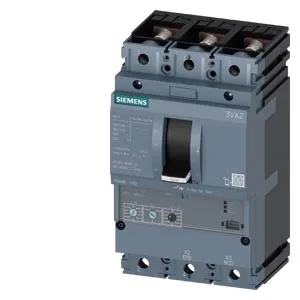
That means the internal trip curve and thermal-magnetic response are tuned for motor inrush and overload profiles, not just general distribution. It's a 3-pole, 40 A frame with phase failure detection built in (cite:), so if you lose a phase upstream, this breaker will see it and trip — a key feature for preventing single-phasing damage on a motor load. No derating curve to chase at elevated panel temps — it holds its rating at 70 °C ambient. That's unusual; most breakers start stepping down above 40 °C. For a panel builder or site engineer, this simplifies the thermal budget in a crowded enclosure.
This MCCB carries a massive 187 kA interrupting rating at 240 V (cite:), dropping to 121 kA at 415 V and 440 V (cite:–), then 75.6 kA at 500 V (cite:). At 690 V it's still rated 3.7 kA (cite:). Those are the maximum fault currents it can safely clear without welding or rupturing. The short-time delay range is 4 to 17 seconds (cite:–), which gives you selectivity bandwidth downstream. If a feeder breaker needs to hold through a motor start (typically 6–10 seconds of locked-rotor current), you can set this to ride through without nuisance tripping on the main.
Built-in accessories — no add-on modules needed
No separate accessory kit to order and install; it's all integrated at the factory.