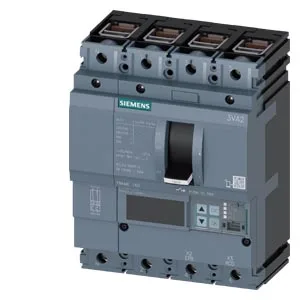
It carries a 242 kA breaking capacity at 240 V, dropping to 187 kA at 415 V and 440 V, 121 kA at 500 V, and 3.7 kA at 690 V — the high short-circuit ratings at lower voltages suit it for fault-current-heavy installations like transformer secondaries or main feeders. Ground-fault monitoring is built in via summation current formation on L + N conductors, so it handles both overcurrent protection and ground-fault detection in a single device — no separate GFCI module needed on the load side.
The 40 A full-scale value is the breaker's continuous current rating at 40 °C through 70 °C — per the datasheet, it holds 40 A across that entire ambient range (–), so no derating curve to calculate for typical panel interiors up to 70 °C. The adjustable thermal-magnetic trip range spans 60 A minimum to 480 A maximum, which means the magnetic instantaneous pickup can be set anywhere within that window; for a 40 A frame, the 60 A minimum is the lowest short-circuit trip threshold available. The 86 mm depth and 140 mm width are the panel cutout dimensions you need to verify against your existing busbar and mounting footprint; the 181 mm height clears most standard distribution panelboards.
Integration notes for panel builders
The communication function enables remote monitoring or integration with a BMS or SCADA system via the SENTRON communication modules; verify the specific protocol (PROFIBUS, PROFINET, Modbus) against your controller's fieldbus before specifying the add-on module. Ground-fault monitoring via summation current uses the L + N conductor loop — no external CT required, but the neutral must pass through the breaker's internal sensor. The 1.6 W power loss is low enough that no forced ventilation is needed for a single unit, but in a multi-breaker lineup, sum the losses and check the enclosure's thermal dissipation rating.