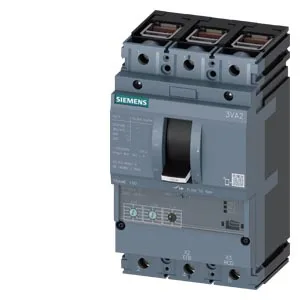
Its interrupting capacity hits 330 kA at 240 V, 242 kA at 415 V and 440 V, 187 kA at 500 V, and 3.7 kA at 690 V — so it clears high-fault scenarios at the lower voltages common in industrial switchgear, while still handling the reduced duty at 690 V. That thermal stability comes from the electronic trip design; a thermal-magnetic breaker would typically need a derate factor above 40 °C.
Power loss is a modest 1.6 W maximum, so heat buildup in a dense row of breakers stays manageable.