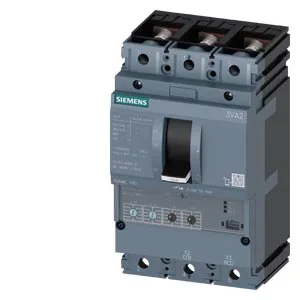
What it is and what it does
The Siemens 3VA2140-7HM32-0AA0 is a SENTRON molded case circuit breaker (MCCB) designed for line protection in three-phase distribution. It carries a continuous rated current of 40 A across the full ambient range from -25 °C to 70 °C — no derating needed up to the enclosure limit. The 3-pole unit is rated for an insulation voltage of 800 V, so it sits comfortably in 400 V and 480 V panels with headroom to spare.
Interrupting capacity — the real number for fault coordination
The interrupting capacity is the spec that decides whether this breaker clears a fault or welds shut. At 240 V it is rated for 330 kA; at 415 V and 440 V it holds at 242 kA; at 500 V it drops to 187 kA; and at 690 V it is 3.7 kA. For a 40 A frame, those are high-interrupt ratings — the kind you need when the transformer is close and the available fault current is stiff. The 690 V figure tells you this is not a 690 V primary breaker; it is a 400–480 V secondary breaker with a very high ceiling at the lower voltages.
Panel fit and mounting
Dimensions are 105 mm wide, 181 mm high, and 86 mm deep — a standard MCCB footprint for this class. The 105 mm width across three poles means it occupies roughly four 27 mm module spaces on a DIN rail, though the SENTRON 3VA series also accepts screw-mounting for bolted busbar connections. The 86 mm depth leaves room for rear-panel wiring without forcing a deeper enclosure than necessary.
Ground-fault monitoring and auxiliary functions
This variant includes a ground-fault monitoring version configured for summation current formation on the L-conductor — it sums the phase currents to detect leakage to ground. There is no undervoltage release, no voltage trip, and no communication function on this order code. The trip indicator is also absent, so fault indication is via the handle position only. Power loss is a modest 1.6 W maximum, which matters when you are stacking multiple breakers in a sealed enclosure and counting the thermal budget.
