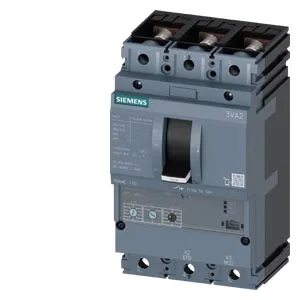
Integrator's note on the 3VA2140-7MN32-0AA0
The Siemens 3VA2140-7MN32-0AA0 is a SENTRON molded case circuit breaker (MCCB) built for motor protection — 40 A continuous current, three poles, with an adjustable trip class selector that lets you pick 10A, 10E, or 20E to match the thermal curve to your motor's starting profile. Breaking capacity runs 330 kA at 240 V, drops to 242 kA at 415 V and 440 V, then 187 kA at 500 V, and 3.7 kA at 690 V — that's a lot of headroom for most distribution panels, but the 690 V number tells you this is a 480 V class breaker being pushed near its insulation limit (rated insulation voltage 800 V).
This part is in the SENTRON 3VA2 family with lifecycle status current.
What the trip class adjustment means on the bench
The adjustable trip class (Tc) gives you 10A, 10E, or 20E. Class 10A is the fastest thermal trip — good for motors that start unloaded and ramp quickly. Class 20E allows longer inrush, suited for high-inertia loads like fans or centrifuges. The 'E' suffix indicates electronic trip, so the curve is more repeatable than a bimetal. Trip indicator is not fitted — no local mechanical flag to show the breaker tripped. If you need visual trip indication at the breaker face, this isn't the variant; look at the -8JQ or -8HM siblings that carry the indicator.