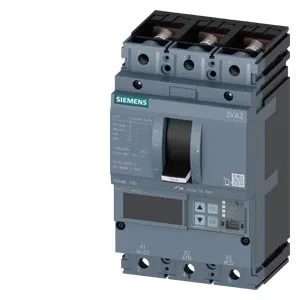
The 3-pole construction and adjustable trip class (selectable between 10A, 10/10E, 20/20E, and 30/30E) let you match the overload curve to the motor start profile, avoiding nuisance trips on high-inertia loads like conveyors or compressors. Breaking capacity is the headline number for a feeder MCCB: this unit delivers 330 kA at 240 V, 242 kA at 415 V and 440 V, 187 kA at 500 V, and 3.7 kA at 690 V. At typical 400 V class industrial voltages, the 242 kA interrupting rating provides ample headroom for high-fault-capacity installations — think large transformer-fed switchboards or motor control centers with upstream transformers above 1 MVA.
Motor protection features and communication
This MCCB includes phase failure detection and a communication function, which allows remote monitoring or integration into a higher-level control system — useful for a plant-wide energy management or predictive maintenance scheme. The absence of an undervoltage release and ground-fault monitoring means those functions must be handled externally if required. The trip indicator is not fitted, so visual status at the breaker face is limited; rely on the communication link or auxiliary contacts (not included) for remote indication.
Panel cutout and busbar spacing should match the 3VA2 footprint — if the existing panel was built for a 3VA1 or 3VA3 frame, the mounting holes and phase centers will differ. Check the depth clearance: 86 mm plus wiring space behind the door.