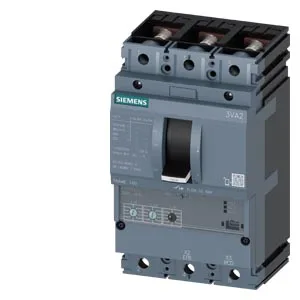
The interrupting rating drops to 121 kA at 415 V and 440 V, 79 kA at 500 V, and 4.25 kA at 690 V, so the voltage class of your system determines the available fault current this breaker can interrupt. The electronic trip unit is an ETU320 — a basic thermal-magnetic replacement with fixed settings, no communication, no undervoltage release, and no ground-fault monitoring. That makes it a straightforward overcurrent protector for feeder circuits where you do not need adjustable curves or remote monitoring. The ETU320 paired with the 63 A frame means the breaker is sized for a 63 A continuous load at ambient temperatures up to 50 °C without derating; at 55 °C it derates to 60.6375 A, at 60 °C to 58.275 A, at 65 °C to 55.9125 A, and at 70 °C to 53.55 A. The front face is rated IP40 — protected against tools and small solids, but not sealed against water, so it belongs in an enclosed panel.
The 86 mm depth is the overall body depth including the front cover; the terminal lugs and arc chutes add a few millimeters behind the panel. The 105 mm width is the standard 3-pole MCCB footprint for the 3VA frame size — it occupies the same slot as any other 3VA 3-pole breaker in a panel layout.
It is designed for high-fault locations — think main breakers in industrial switchboards fed by large transformers, or tie-breakers in a double-ended substation. At 415 V the interrupting capacity is still 121 kA, which covers most European industrial distribution systems.