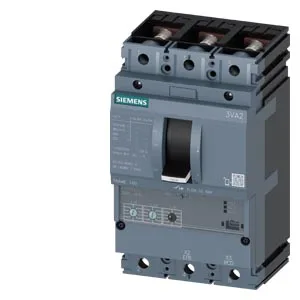
The Siemens 3VA2163-5HL32-0JH0 is a SENTRON 3VA2 series molded case circuit breaker rated for 63 A continuous current (Iu) across 40 °C to 50 °C ambient, with no derating needed in that band. Above 55 °C it steps down linearly to 53.55 A at 70 °C. Interrupting capacity hits 187 kA at 240 V, drops to 121 kA at 415 V and 440 V, then 79 kA at 500 V, and 4.25 kA at 690 V.
ETU320 release and integrated shunt trip
The overcurrent release is an ETU320 electronic trip unit — adjustable, with LSI curves (long-time, short-time, instantaneous). The base switch is 3VA2163-5HL32-0AA0; the -0JH0 suffix adds the shunt trip and the specific aux contact block. Power loss maxes at 4 W — negligible for thermal budgeting inside a closed enclosure. Mechanical endurance is 20,000 operations, which is typical for a 63 A MCCB frame; it's not a switching device for frequent cycling, it's a protection device.
That 105 mm width is the 3-pole frame width for the 3VA2 63 A frame — it's the same physical envelope as other 3VA2 63 A three-pole breakers, so swapping within the family doesn't require re-drilling the mounting plate or re-routing busbars. Depth of 86 mm includes the handle and terminal protrusion; plan for front-access wiring clearance.