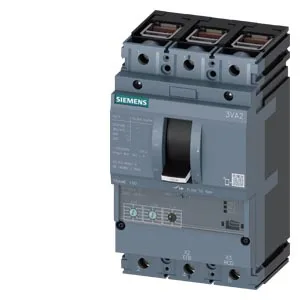
At 415 V and 440 V it still holds 121 kA, dropping to 79 kA at 500 V and 4.25 kA at 690 V. The 3-pole design uses an ETU320 electronic trip unit with no undervoltage release, no voltage trigger, no ground-fault monitoring, and no communication function — it's a straightforward thermal-magnetic replacement with electronic curve shaping, sized for a 63 A feeder.
Above that it derates linearly: 60.6375 A at 55 °C, 58.275 A at 60 °C, 55.9125 A at 65 °C, and 53.55 A at 70 °C (–). If the breaker lives inside a hot enclosure near transformers or drives, use the 70 °C figure — that's the operating maximum. The thermal derating is built into the ETU320's sensing, not a separate de-rating factor you apply manually. The front face carries an IP40 protection class, which means no water spray protection; keep it inside the enclosure, not on a wet panel door.
Auxiliary contacts and trip indicator
Comes with 3 auxiliary switches HQ — that's three form-C (changeover) contacts for remote status feedback. No trip indicator on the front, so if you need visual trip flagging at the breaker, you'll rely on the auxiliary contacts wired to a panel lamp or PLC input. The supplied basic switch variant is 3VA2163-5HL36-0AA0, which is the same breaker without the auxiliary contacts — this -0AD0 version adds the three switches as a factory-installed option.
Power loss is 4 W maximum — negligible for panel thermal budgeting.