Interrupting capacity and selectivity
The 3VA2163-5HL36-0BL0: The interrupting capacity is not a single number — it is a curve across system voltages: 187 kA at 240 V, 121 kA at 415 V and 440 V, 75.6 kA at 500 V, and 3.7 kA at 690 V. For a site electrical engineer planning a selective coordination study, the 121 kA at 415 V means this breaker can sit downstream of a transformer rated for a 100 kA fault current and still hold coordination with a slower upstream device. The sharp drop at 690 V (3.7 kA) is typical for a 3-pole MCCB on a 690 V line — the arc-extinction challenge at that voltage limits the rating, so if your system runs 690 V, verify the available fault current is under that threshold.
Integration and mounting
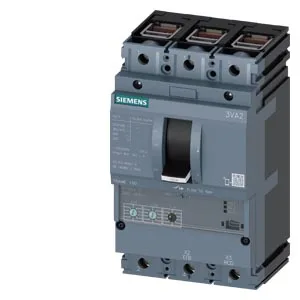
Dimensions: 105 mm wide, 181 mm high, 86 mm deep. That 105 mm width is the standard 3-pole MCCB footprint for the SENTRON 3VA2 frame — it fits the same panel cutout as the 3VA2 family. IP40 on the front means the breaker face is protected against tools and solid objects over 1 mm, but not sealed against water; mount it inside a panel rated for the environment. The ETU320 trip unit is electronic, not thermal-magnetic, so the trip curve is programmable via the front interface — no heater elements to age, but the power loss is 6.5 W maximum, which adds to the enclosure's thermal budget.
