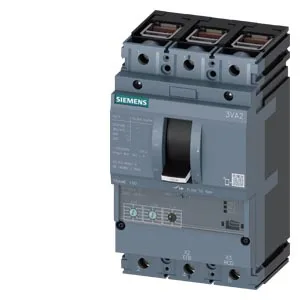
Interrupting capacity hits 187 kA at 240 V AC, stepping down to 121 kA at 415 V and 440 V, 75.6 kA at 500 V, and 3.7 kA at 690 V.
Current setting range and selectivity
The electronic trip unit adjusts from 95 A minimum to 756 A maximum — that's a roughly 8:1 range, which gives the specifying engineer room to coordinate downstream feeders without swapping the breaker frame. The 63 A continuous rating is the thermal base; the adjustable trip covers the overload and short-circuit thresholds within that window. For a 480 V distribution panel, the 121 kA interrupting at 415 V/440 V means it can sit ahead of a 100 kA-rated downstream MCCB and still hold coordination.
Shunt trip and auxiliary release
The shunt trip is voltage-triggered (confirms a voltage trigger). No undervoltage release is fitted, so the breaker stays closed on control power loss unless the shunt trip is explicitly energized. That's the usual choice for applications where you don't want a nuisance trip on a 24 VDC dip.
The 86 mm depth keeps it within typical 200 mm deep enclosure clearances.