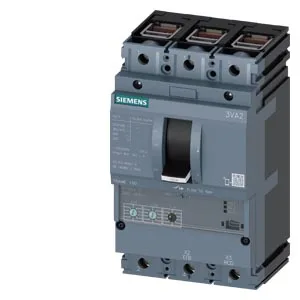
Siemens 3VA2163-5HL36-0JL0 SENTRON MCCB — 63 A, 3-Pole, Line Protection
The Siemens 3VA2163-5HL36-0JL0 is a SENTRON molded case circuit breaker (MCCB) rated for 63 A continuous current across its full ambient temperature range from 40 °C to 70 °C — no derating needed up to that ceiling. It's a 3-pole, line-protection design (not a motor-protective or ground-fault version), so it's sized for feeder or main breaker duty in a distribution panel, not for individual motor starting. The interrupting ratings are the headline: 187 kA at 240 V AC, 121 kA at 415 V and 440 V, 75.6 kA at 500 V, and 3.7 kA at 690 V. That 187 kA figure at 240 V tells you this breaker handles high available fault current — typical for a main or large subfeed in a 240/120 V panelboard. At 415/440 V it still clears 121 kA, which is well above what most industrial distribution transformers can deliver. The 3.7 kA at 690 V is a tail-off; if you're on a 690 V system, verify the available fault current stays under that.
Physical Fit and Auxiliary Options
Dimensions: 105 mm wide, 181 mm high, 86 mm deep. That 86 mm depth is the body only — factor in the handle throw and any rear-mounted accessories when you lay out the panel. The breaker ships with a shunt trip (STL) release and a full auxiliary switch complement: 2 auxiliary switches + 1 trip alarm switch + 1 electrical alarm switch (HQ configuration). That's enough for remote status indication and a shunt-trip command without adding external relays. It also carries a trip indicator and a voltage trigger — so you get visual and electrical confirmation that the breaker has opened on fault, not manually. No undervoltage release, no communication module, no ground-fault monitoring on this variant. If you need those, you're looking at a different suffix on the 3VA2 family.
Environmental and Operating Range
Operating temperature: -25 °C to +70 °C. Storage range: -40 °C to +80 °C. Maximum power loss is 4 W — negligible for panel thermal budgeting. The 63 A rating holds flat across the whole operating range, so you don't need to derate for a warm enclosure up to 70 °C.
