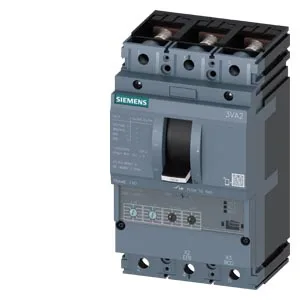
The Siemens SENTRON 3VA2163-5HN32-0CC0 is a 3-pole molded case circuit breaker rated for 63 A continuous current at up to 50 °C ambient, with a 187 kA interrupting capacity at 240 V and 121 kA at 415 V.
How the ratings hold up in a real panel
Above 50 °C it steps down: 60.6375 A at 55 °C, 58.275 A at 60 °C, 55.9125 A at 65 °C, and 53.55 A at 70 °C. The 187 kA at 240 V and 121 kA at 415 V mean this MCCB can clear a fault as high as 187 kA without welding its contacts or venting arc gas into the enclosure — that's important for high-capacity transformer secondaries or busway feeds.
What the ETU350 trip unit does — and doesn't do
The ETU350 is an electronic overcurrent release with line protection — it responds to overload and short-circuit conditions. It does not include ground-fault monitoring, phase-failure detection, or communication functions. The 20,000 mechanical endurance cycles (latching) suit it for applications that see occasional switching, not daily motor starting. Power loss is 6.5 W maximum, so heat buildup in a sealed enclosure is manageable but worth checking if the panel runs near 70 °C ambient.