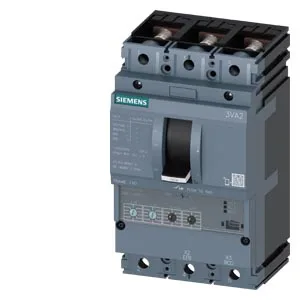
That flat thermal curve is unusual; most MCCBs start derating above 40 °C. For a panel OEM or site engineer, it means the breaker holds its 63 A rating even in a hot enclosure near a drive or transformer, which simplifies coordination studies and avoids a larger frame just for thermal headroom. The interrupting capacity tells the real story for fault duty. At 240 V it clears 187 kA — a very high figure for a 63 A frame, sized for large transformer secondaries or high-capacity busway. At 415 V it still holds 121 kA, and at 500 V it's 75.6 kA. For the common 400 V class, 121 kA covers virtually all industrial switchboards.
Built-in accessories and deployment context
That's enough for remote status indication and undervoltage protection without adding external relays. The trip indicator on the front gives a visual flag for a tripped state — useful during commissioning or fault-finding when you're scanning a row of breakers. Dimensions are 105 mm wide, 181 mm tall, 86 mm deep — a 3-pole frame that fits most 600 V-class distribution sections. Maximum power loss is 6.5 W, so heat buildup in a dense panel is manageable.