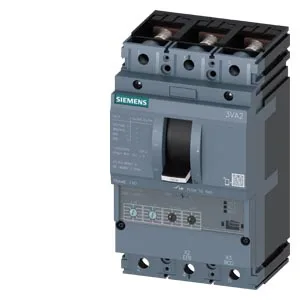
The Siemens SENTRON 3VA2163-5HN32-0KA0 is a 3-pole molded case circuit breaker (MCCB) rated for a continuous 63 A across the full ambient range from 40 °C to 70 °C — no derating curve to chase, provided the panel stays within that envelope. Interrupting capacity sits at 187 kA at 240 V, stepping down to 121 kA at 415 V and 440 V, then to 75.6 kA at 500 V, and 3.7 kA at 690 V; that spread tells you the breaker is sized for high-fault commercial and industrial distribution, not a motor-only branch. The integrated shunt trip release (STL) means a remote trip signal can drop the breaker independently of the overload or short-circuit mechanism — a common requirement for emergency-off circuits or undervoltage protection schemes in larger switchgear assemblies.
The breaker occupies 105 mm width, 181 mm height, and 86 mm depth — a compact footprint for a 63 A frame with this interrupting capacity. Panel builders should verify the gland-plate cutout matches the 3-pole mounting pattern; the SENTRON 3VA series uses a common baseplate footprint across the family, so a panel drilled for a 3VA2163-8HM32-0AA0 will accept this unit without rewiring, provided the lug kit and accessory positions are identical. The shunt trip adds a pair of control wires; plan for a 24 VDC or 110-240 VAC trip signal depending on the coil variant ordered alongside the breaker.
Selectivity & Coordination
The interrupting capacity at 415 V (121 kA) and 500 V (75.6 kA) gives the engineer headroom for selective coordination with downstream breakers in a high-fault industrial distribution board — provided the upstream transformer impedance and cable lengths are accounted for in the arc-flash study. The 63 A continuous rating holds flat to 70 °C, which is unusual for a thermal-magnetic MCCB; that means the breaker can sit in a warm top-of-panel position without a forced derating factor, as long as the ambient at the breaker enclosure stays under 70 °C.