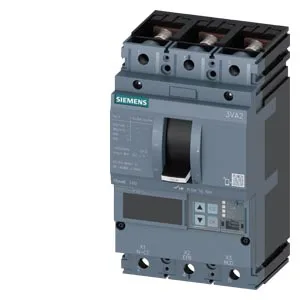
The 3-pole unit breaks up to 187 kA at 240 V AC, dropping to 121 kA at 415 V, and still handles 75.6 kA at 500 V. The interrupting capacity at 690 V is 3.7 kA, so this frame is sized for 240–500 V distribution, not 690 V motor circuits.
The UVR is the release type, not a separate module — it drops the breaker when control voltage is lost, which is the standard fit for emergency-stop or undervoltage protection schemes. A communication function is also present on this variant, meaning it can report status or accept remote trip signals without an external add-on. The trip indicator is mechanical, visible on the front face.
The 86 mm depth is the overall dimension including the handle and terminals — verify panel depth clearance if the breaker is installed in a shallow enclosure with a door-mounted operator.
The adjustable overload range runs from a minimum of 95 A to a maximum of 756 A — note that 95 A is the lowest pickup setting, not the continuous rating. The continuous rating is fixed at 63 A. The wide adjustment band allows the breaker to be selectively coordinated with downstream 63 A or 100 A feeders, but the frame itself is a 63 A continuous device. For selectivity tables, Siemens publishes coordination curves for the 3VA2 frame; the 187 kA at 240 V and 121 kA at 415 V give headroom for high-fault installations like transformer secondaries or large panelboards.