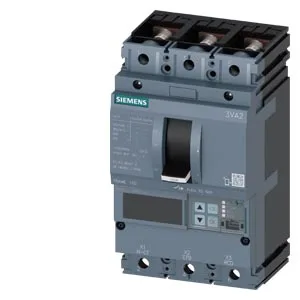
It's rated 63 A continuously across the full ambient range from 40 °C to 70 °C with no derating, which simplifies panel sizing in warm enclosures. The interrupting rating hits 187 kA at 240 V and 121 kA at 415 V, so it handles high-fault-current scenarios common in industrial switchboards without needing a current-limiting upstream device. Communication function is built in, so it can report trip events and load data over a bus system without an add-on module.
The breaker measures 105 mm wide, 181 mm tall, and 86 mm deep — a standard SENTRON 3VA2 footprint that drops into existing Siemens panelboards and switchgear without drilling new mounting holes.
What the interrupting ratings mean for coordination
The 187 kA at 240 V and 121 kA at 415 V tell you this breaker can clear a bolted fault at those levels without rupturing. For selectivity studies, the 63 A frame with those interrupting numbers means it can be used downstream of a larger MCCB or fused switch without exceeding its short-circuit withstand. At 690 V the rating drops to 3.7 kA — that's a grounded-wye corner or IT system limit; verify the available fault current if your panel runs 690 V.