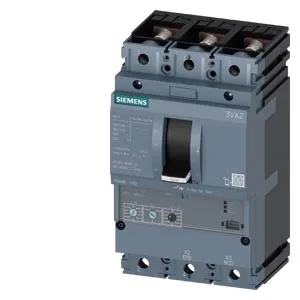
The Siemens SENTRON 3VA2163-5MN32-0DH0 is a 3-pole molded case circuit breaker rated for 63 A continuous current across the full ambient range from 40 °C to 70 °C — no derating needed up to that ceiling. It is designed specifically for motor protection, with integrated phase failure detection and a trip indicator. The interrupting capacity reaches 187 kA at 240 V, 121 kA at 415/440 V, and 75.6 kA at 500 V, dropping to 3.7 kA at 690 V. The UVR drops the breaker when control voltage falls below a threshold — standard for motor circuits that must not auto-restart after a power dip. The auxiliary switch configuration (2 aux + 1 trip alarm) gives the PLC or safety relay a clean status signal for both the breaker position and the trip event, without needing an external interlock block.
The basic switch order code is 3VA21635MN320AA0, which is the internal switching core; the full assembly includes the UVR and auxiliary switch pack as a factory-integrated unit.
Maximum power loss is 6.5 W at rated load. In a sealed enclosure with multiple breakers ganged together, that 6.5 W per pole stack matters — a panel with six of these breakers at full load dissipates 39 W, which may drive a small ventilation slot or a larger enclosure volume to keep internal ambient below the 70 °C operating maximum.