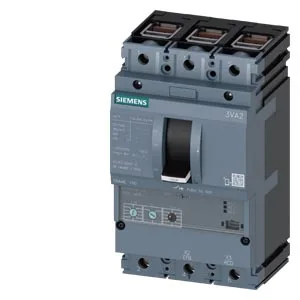
The Siemens SENTRON 3VA2163-5MN36-0CC0 is a 3-pole molded case circuit breaker (MCCB) rated 63 A continuously across its full ambient range from 40 °C to 70 °C — no derating needed up to that ceiling. The 187 kA breaking capacity at 240 V means it can interrupt high fault currents on a 240 V distribution bus without upstream fuses; at 415 V it still clears 121 kA, so it handles most industrial supply faults. That's a lot of interruption in a 105 mm wide package.
The interrupting rating drops as voltage rises: 187 kA at 240 V, 121 kA at 415 V and 440 V, 75.6 kA at 500 V, and 3.7 kA at 690 V. For most 400 V class panels, the 121 kA rating covers even high-capacity transformer feeds.
Motor protection and auxiliary hardware
This MCCB is explicitly designed for motor protection, which means the trip curve and thermal-magnetic response are tuned for motor inrush and overload profiles. It ships with two HQ auxiliary switches and an undervoltage release (UVR) — the UVR will trip the breaker if control voltage drops, which is common in safety circuits that need a loss-of-voltage shutdown. The basic switch assembly is order code 3VA21635MN360AA0, so if you need a replacement mechanism, that's the sub-component.
Maximum power dissipation is 6.5 W, so thermal buildup in a sealed enclosure is manageable but should be factored into the panel cooling calculation if multiple breakers are ganged.