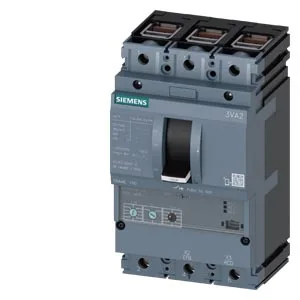
Breaking capacity is where this part earns its keep: 187 kA at 240 V, 121 kA at 415 V and 440 V, 75.6 kA at 500 V, and 3.7 kA at 690 V. Those numbers mean it can sit downstream of a large transformer or in a high-fault industrial distribution panel and still clear a bolted fault without welding its contacts shut. For a motor protection MCCB, that's serious interrupting capability — it keeps the line up when a motor winding shorts.
Built-in protection features for motor circuits
The UVR drops the breaker if supply voltage falls below a set threshold, so a motor doesn't try to start under a brownout and cook itself. Phase failure detection catches a lost phase on a three-phase system and trips before single-phasing damages the motor windings. It also has a trip indicator so you can see at a glance whether it opened on a fault or was manually switched. That gives you status feedback for a PLC or remote monitoring — the trip alarm tells you the breaker opened on a fault, the electrical alarm signals the UVR state, and the aux switches mirror the main contact position. For a motor control center or a remote pump panel, that feedback saves a trip out to check the breaker handle.
The 86 mm depth means it fits in shallow enclosures where a deeper MCCB would hit the back wall. Power loss is 6.5 W maximum, so heat buildup in a sealed cabinet is manageable. That covers most industrial environments from a cold warehouse to a hot compressor room. The -25 °C lower limit means it's fine for unheated equipment sheds in most climates — no need for a heater in the panel just for the breaker.