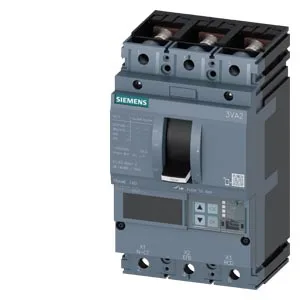
What this MCCB does on the line
Rated 63 A continuously across the full ambient range from 40 °C up to 70 °C (no derate needed), it handles the sustained current draw of a motor circuit without nuisance tripping on warm days. The 3-pole construction matches three-phase motor feeds, and the 121 kA breaking capacity at 415 V gives real fault-clearing headroom for industrial distribution where upstream transformers can deliver serious short-circuit current.
The interrupting ratings tell you where this MCCB can sit in a distribution hierarchy. At 240 V it clears 187 kA; at 415 V and 440 V it holds 121 kA; at 500 V it drops to 75.6 kA; at 690 V it is down to 3.7 kA. That steep fall-off above 500 V is typical for a 63 A frame — the arc energy at 690 V exceeds what the compact arc chute can extinguish at high current. At 690 V, the 3.7 kA limit restricts it to low-fault-capacity sub-circuits or requires a series-rated combination.
Dimensions are 105 mm wide, 181 mm tall, 86 mm deep — a standard 3-pole MCCB footprint for DIN-rail or screw-mount installation in a distribution board or motor control center. Operating temperature range is -25 °C to 70 °C; storage from -40 °C to 80 °C covers most unheated warehouse conditions.