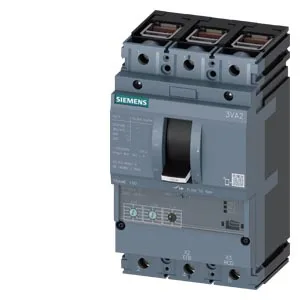
The Siemens 3VA2163-6HL36-0JL0 is a SENTRON molded case circuit breaker (MCCB) rated for 63 A continuous current across the full 40 °C to 70 °C ambient range — no derating needed up to that ceiling. The interrupting capacity is the headline number here: 242 kA at 240 V, dropping to 187 kA at 415/440 V, 121 kA at 500 V, and 3.7 kA at 690 V.
Fit and footprint for panel integration
The 3VA2163-6HL36-0JL0 measures 86 mm deep, 105 mm wide, and 181 mm tall. That 105 mm width for a 3-pole MCCB is standard for the SENTRON 3VA frame — it occupies three 35 mm DIN-rail modules worth of panel width. The 86 mm depth is important for enclosure selection: it fits standard 200 mm deep wall-mount enclosures with clearance for rear-mounted busbars or cable ducts. The breaker ships with a factory-fitted auxiliary switch configuration: 2 auxiliary switches + 1 trip alarm switch + 1 electrical alarm switch (HQ type), plus a shunt trip (STL) release. That means it arrives ready for remote status monitoring and emergency tripping without additional field wiring of accessories.
The 63 A continuous rating holds flat from 40 °C to 70 °C ambient — no thermal derating curve to calculate for typical panel environments up to that temperature. The maximum rating of 756 A is the short-circuit making/breaking capacity at the lower voltage end, not a continuous rating.