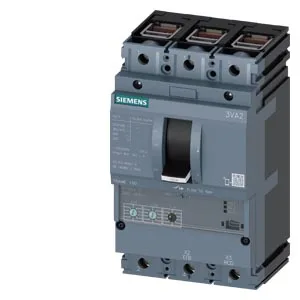
What this MCCB is and where it fits
The Siemens SENTRON 3VA2163-6HL36-0KL0 is a 3-pole molded case circuit breaker rated for 63 A continuous current at 40 °C, designed for line protection in distribution panels and industrial switchboards. Its breaking capacity hits 242 kA at 240 VAC and 187 kA at 415 VAC — numbers that tell you this breaker handles high-fault points-of-coupling, not just downstream feeder duty. The 3VA2163-6HL36-0KL0 carries a shunt trip (STL) auxiliary release and a 2+1+1 auxiliary switch configuration (2 auxiliary switches, 1 trip alarm, 1 electrical alarm), so it integrates into safety circuits or remote-trip schemes without a separate accessory stack.
Current rating and thermal performance
Rated 63 A continuous at 40 °C, and the rating holds flat all the way to 70 °C — no derating curve to chase across the ambient range. That means a panel running hot near the top of its 70 °C operating limit still carries the full 63 A without nuisance tripping. The adjustable thermal-magnetic trip range spans from 95 A minimum to 756 A maximum, giving the commissioning engineer room to tailor the instantaneous pickup to the load's inrush profile.
Breaking capacity across voltage levels
Breaking capacity is the headline number that decides whether this breaker survives a fault or explodes. At 240 VAC it clears 242 kA; at 415 V and 440 V it holds 187 kA; at 500 V it still manages 121 kA. The drop to 3.7 kA at 690 V is the only voltage point where you'd question its application — that's a deliberate design trade-off for the high-voltage end of the curve. In a 400 V-class panel (the most common industrial distribution voltage), 187 kA SCCR gives ample headroom for transformer-fed main breakers and bus-riser protection.
Panel integration and physical fit
Dimensions are 105 mm wide, 181 mm high, 86 mm deep — a standard 3-pole MCCB footprint that drops into most Siemens SENTRON panelboards and third-party enclosures without re-drilling. The 86 mm depth (3.39 in) is shallow enough for shallow-profile wall-mount enclosures; the 105 mm width (4.13 in) matches the typical 3-pole mounting centers. No undervoltage release fitted from the factory — that's a field-install accessory if your safety circuit demands it. Ground-fault monitoring is also absent on this variant, so if you need GF protection, you're looking at a different suffix or an external module.
Auxiliary switching and control wiring
The auxiliary switch complement — 2 auxiliary switches + 1 trip alarm switch + 1 electrical alarm switch HQ — gives you four discrete signal paths for status feedback to a PLC, SCADA, or annunciator panel. The shunt trip (STL) release allows remote tripping via a control voltage, which is standard for emergency-stop circuits or undervoltage-coordination schemes. Power loss at rated current is 4 W maximum — negligible for thermal budget in a densely packed panel.
Environmental limits and storage
Operating temperature range is -25 °C to 70 °C; storage range extends from -40 °C to 80 °C. The storage maximum of 80 °C is the handling limit — don't leave it in a hot truck or roofed warehouse in summer without checking the internal packaging. The operating minimum of -25 °C covers cold-start conditions in unheated switchrooms or outdoor enclosures in temperate climates.
