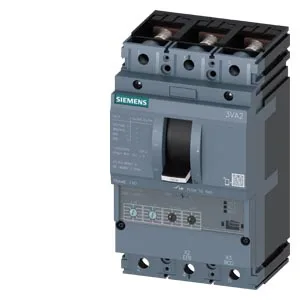
Siemens 3VA2163-6HN32-0AD0 — 63 A SENTRON MCCB for Line Protection
The Siemens 3VA2163-6HN32-0AD0 is a 3-pole SENTRON molded case circuit breaker rated for 63 A continuous current at 40 °C, carrying the same 63 A rating up through 50 °C before it starts to derate. It's built for line protection duty — meaning it's the main guard between the feeder and the distribution, not a motor-protection breaker with thermal/ magnetic curves tuned for starting inrush. The interrupting ratings tell the real story: 242 kA at 240 V, 187 kA at 415 V and 440 V, 121 kA at 500 V, and 5 kA at 690 V. That's a lot of fault-clearing headroom for a 63 A frame, which means you can put this thing upstream in a high-fault-current panel and not worry about it welding shut on a bolted fault. The electronic trip unit is an ETU350 — that's the adjustable thermal-magnetic replacement with LSI curves (long-time, short-time, instantaneous). You get three auxiliary switches HQ built into the base, so you don't have to stack add-on blocks for status feedback back to the PLC or SCADA. The latching endurance is rated for 20,000 operations, which is typical for a fixed-mounted MCCB that sees occasional switching, not daily contactor duty. Panel footprint is 105 mm wide by 181 mm tall by 86 mm deep — that's a standard 3-pole MCCB cutout for the SENTRON 3VA2 family. The power loss maxes out at 4 W, so heat buildup in a dense cabinet is manageable.
Above that, it derates to 60.6 A at 55 °C, 58.3 A at 60 °C, 55.9 A at 65 °C, and 53.6 A at 70 °C. The ETU350 release gives you adjustable long-time pickup (Ir), short-time pickup (Sd), and instantaneous (Ii). That means you can fine-tune coordination with downstream breakers without swapping trip units. The auxiliary contacts — three of them, HQ quality — are wired in at the factory, so you don't need to open the breaker to install them later. That saves panel-build time and reduces the chance of wire-nest errors. But on standard 240 V to 500 V systems, the interrupting capacity is more than adequate for most industrial service entrances and sub-feeders.