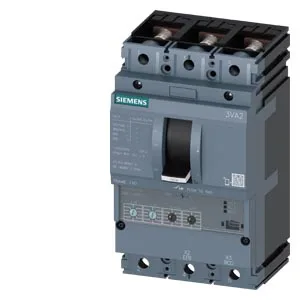
Breaking capacity hits 242 kA at 240 V, 187 kA at 415 V and 440 V, 121 kA at 500 V, and 3.7 kA at 690 V — the high 240 V figure tells you this unit is built for low-voltage high-fault installations, common in industrial distribution where transformer ratings push available fault current.
The 756 A rated current (both minimum and maximum) is the frame rating — the maximum current the breaker's thermal-magnetic trip unit can handle without damage. The 63 A continuous rating is the actual load current it's set to protect; the frame gives headroom for future upsizing if needed. Power loss is 4 W maximum — low enough that multiple breakers can be ganged in a panel without forced cooling, but worth summing across all poles in a dense layout to stay within enclosure thermal limits. Dimensions: 105 mm wide, 181 mm high, 86 mm deep — the 105 mm width is the standard 4-module footprint for this frame size, so it drops into existing SENTRON panelboards without re-drilling gland plates.
Integrated accessories
The basic switch inside is order code 3VA2163-6HN32-0AA0 — if you're replacing just the switching mechanism, that's the sub-assembly to order. If you need those, you'd step to a different variant in the 3VA2 family.