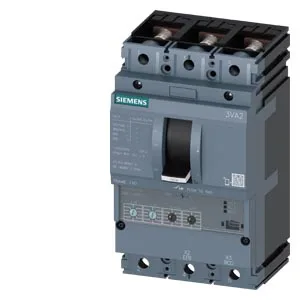
Its headline breaking capacity hits 330 kA at 240 V, dropping to 242 kA at 415 V and 440 V, then 187 kA at 500 V, and 5.25 kA at 690 V — that 330 kA figure at 240 V means it can safely interrupt very high fault currents in low-voltage distribution, typical for large transformer-fed switchboards or industrial main feeders where available fault current is substantial.
The breaker holds its full 63 A rating up to 50 °C ambient, then derates linearly: 60.6375 A at 55 °C, 58.275 A at 60 °C, 55.9125 A at 65 °C, and 53.55 A at 70 °C. Maximum power dissipation is 6.5 W, so heat buildup in a sealed enclosure is manageable.
The trip indicator is present, so a local flag shows whether the breaker opened on a fault vs. manual operation.
The storage minimum matters for warehousing in unheated facilities — this breaker can sit in a -40 °C freezer warehouse without damage, but must be warmed before energizing to avoid condensation. Rated insulation voltage (Ui) is 800 V, which covers most 400/480 V systems with margin, and the 690 V breaking capacity of 5.25 kA is the low end — so on a 690 V system, verify the available fault current is under that threshold.