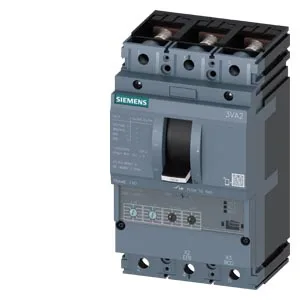
It carries a maximum interrupting rating of 330 kA at 240 V, dropping to 242 kA at 415 V and 440 V, 187 kA at 500 V, and 3.7 kA at 690 V — so the high short-circuit capacity at lower voltages means it can sit close to the transformer or service entrance without needing an upstream current-limiting fuse.
That's unusual; most breakers start tapering above 40 °C. The 3-pole construction handles three-phase circuits, and the line-protection design (not motor-protection) means the thermal-magnetic trip curve is shaped for feeder and branch-circuit fault clearing, not for starting inrush.
Deployment context
Mounts in a distribution panel or enclosure on a standard MCCB mounting plate. The 86 mm depth means it clears most shallow enclosures, but verify gland-plate clearance if back-panel wiring is tight. The undervoltage release adds a control-wire connection — plan for a separate 24 VDC or 110 VAC control circuit depending on the UVR coil rating (not listed here, but typical for SENTRON UVRs).