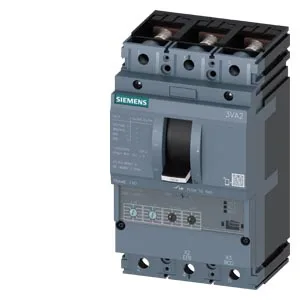
That flat thermal performance means the breaker holds its trip threshold in a hot switchgear lineup or a poorly ventilated enclosure, which is exactly the kind of concurrent-maintainability detail a Tier-III facility engineer flags during the load-study review. Three-pole design, configured for line protection. Breaking capacity ramps from 330 kA at 240 VAC down to 3.7 kA at 690 VAC — the 330 kA figure at 240 V is the headline number for high-fault utility feeds in North American data-center distribution. The shunt trip lets a remote protection relay or fire-alarm system drop the breaker without manual intervention — essential for emergency power-off sequences and generator synchronizing schemes.
The 105 mm width occupies three pole positions on a DIN-rail or panel-mount footprint — verify the existing bus-bar takeoff spacing if replacing a different manufacturer's frame.
Coordination and selectivity notes
Rated for line protection, meaning it's the feeder-side breaker in a selective coordination study. The 63 A frame with up to 330 kA SCCR at 240 V gives headroom for a high-fault utility transformer secondary. Downstream branch breakers must be selected to coordinate below the let-through curve of this MCCB — Siemens publishes selectivity tables for the 3VA series that cover the common branch-frame sizes.