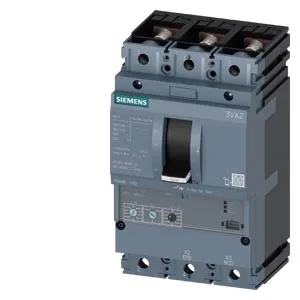
That means it can sit in a warm panel next to a drive or transformer and still deliver its full 63 A without a second look. Breaking capacity climbs to 330 kA at 240 V, drops to 242 kA at 415 V and 440 V, then 187 kA at 500 V, and 3.7 kA at 690 V. For most motor branch circuits at 400–480 V, the 242 kA figure gives ample headroom even on high-fault panels.
Motor protection design and auxiliary complement
This variant is explicitly a motor protection design, meaning the thermal-magnetic trip curve is shaped for motor inrush — it rides through the starting transient without nuisance tripping, then clears on sustained overload. Phase failure detection is standard, so if one leg drops, the breaker opens before single-phasing cooks the winding. That's a feature you'd normally pay extra for on a basic thermal-magnetic MCCB. That gives you two independent status signals (open/closed) plus a dedicated alarm contact that changes state only when the breaker trips on fault — useful for a remote SCADA input or a local beacon. The basic switch variant is 3VA2163-7MN32-0AA0 if you need the base unit without auxiliaries.
No special cutout needed beyond the usual SENTRON 3VA pattern.