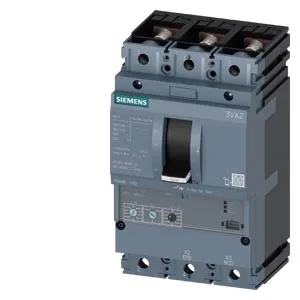
The Siemens SENTRON 3VA2163-7MN32-0JH0 is a 3-pole molded case circuit breaker (MCCB) rated for 63 A continuous current across the full ambient temperature range from 40 °C to 70 °C — no derating needed up to that ceiling. This is the motor protection design variant, so it includes phase failure detection — a feature that trips the breaker if one phase drops out, preventing single-phasing damage to a motor load. The basic switch itself is order code 3VA2163-7MN32-0AA0, meaning this -0JH0 suffix adds the auxiliary and shunt trip hardware at the factory.
Mounting is via the rear DIN rail clip; no additional panel cutout required. The shunt trip wiring lands on the integrated terminal block, and the auxiliary switch contacts are accessible at the front of the breaker for control wiring.
Breaking Capacity Profile
The interrupting capacity varies significantly with system voltage: 330 kA at 240 V, 242 kA at both 415 V and 440 V, 187 kA at 500 V, and 3.7 kA at 690 V. The time-delay settings range from a minimum of 4 s to a maximum of 17 s, giving you a window to coordinate with downstream devices on a selective trip scheme.
Environmental and Electrical Ratings
Maximum power loss is 4 W — negligible for panel thermal budgeting. The undervoltage release is not fitted, and there is no ground-fault monitoring module. Communication function is absent, so this is a standalone thermal-magnetic breaker, not a power-metering or networked device.