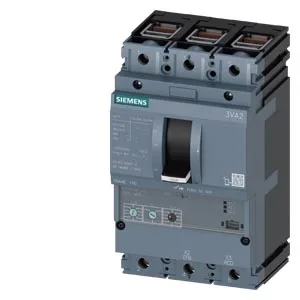
The Siemens SENTRON 3VA2163-7MN36-0AB0 is a 3-pole molded case circuit breaker (MCCB) rated for a continuous 63 A across the full ambient range from 40 °C to 70 °C — no derating needed as the panel warms up.
Interrupting capacity is where this MCCB earns its keep in a distribution panel. At 240 V it's rated for 330 kA — that's a massive fault current, typical for a main breaker position close to a large transformer. At 415 V and 440 V it still handles 242 kA, and at 500 V it's 187 kA. The steep drop to 3.7 kA at 690 V tells you this is a 480 V class breaker, not a 690 V main. For a motor protection MCCB on a 480 V line, the 187 kA at 500 V gives you plenty of headroom for most industrial service entrances.
Built-in auxiliary switches and trip characteristics
This MCCB comes with two high-performance auxiliary switches (HP type) factory-installed, so you get remote status indication without adding a separate accessory block. The trip unit has a minimum delay of 4 s and a maximum of 17 s — that's the thermal-magnetic or electronic trip band for motor starting. Power loss is a modest 4 W maximum.
The base switch variant is 3VA2163-7MN36-0AA0 if you need the bare breaker without the auxiliary switches.