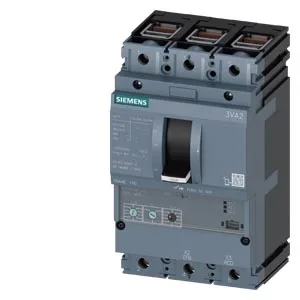
SENTRON 3VA2163-7MN36-0BC0 — Motor Protection MCCB, 63 A, Current Production
The Siemens SENTRON 3VA2163-7MN36-0BC0 is a 3-pole molded case circuit breaker (MCCB) designed specifically for motor protection, rated at 63 A continuously at 40 °C ambient. It carries a full-load current rating that holds flat from 40 °C up through 70 °C — no derating needed across that span, which simplifies panel thermal budgeting when the breaker shares an enclosure with other heat sources. Breaking capacity reaches 330 kA at 240 V, stepping down to 242 kA at 415 V and 440 V, then 187 kA at 500 V, and 3.7 kA at 690 V. That 330 kA figure at 240 V is the headline number for high-fault industrial panels — it means this breaker can safely interrupt a fault up to that level without cascading upstream, provided the available fault current at its mounting point stays within that limit. The steep drop to 3.7 kA at 690 V is typical for a 63 A frame; at that voltage the internal arc extinction limits the interrupting capability, so verify the system voltage against the published curve.
Motor Protection Design and Auxiliary Components
This MCCB is explicitly designed for motor protection, which means its trip curve is shaped to handle motor inrush without nuisance tripping while still providing short-circuit and overload protection for the motor branch circuit. It includes phase failure detection — a critical feature for three-phase motor loads, where a lost phase can single-phase the motor and cause overheating if not interrupted. The breaker ships with an integrated undervoltage release (UVR) and two HQ auxiliary switches. The UVR trips the breaker when control voltage drops below a set threshold — standard for safety circuits that need to drop power on loss of control supply. The auxiliary switches provide status feedback (open/closed) to a PLC or indication lamp. The basic switch variant is 3VA2163-7MN36-0AA0, which is the core switching mechanism; the -0BC0 suffix adds the UVR and auxiliary switch complement. No communication function is built in — this is a standalone thermal-magnetic or electronic trip unit without Modbus or PROFIBUS interface. If you need remote trip indication or energy monitoring, you would add an external communication module or use the auxiliary switch contacts for hardwired status.
Physical Fit and Environmental Limits
Dimensions are 181 mm height, 105 mm width, 86 mm depth. That 105 mm width is the standard 3-pole MCCB footprint for this SENTRON frame size — it occupies three 35 mm DIN-rail module spaces (each roughly 35 mm wide) plus a small margin. Panel cutout and enclosure depth must accommodate the full 86 mm depth, including the rear arc-chamber clearance. The 181 mm height is the body height; allow additional clearance above for wiring and below for the arc vent. Operating temperature range is -25 °C to 70 °C; storage range is -40 °C to 80 °C. The 70 °C operating maximum matches the flat current rating — no derating needed up to that limit. Maximum power loss is 6.5 W, which is modest for a 63 A MCCB and helps keep enclosure internal temperature rise manageable.
Selectivity and Coordination Notes
The trip times are specified with a minimum of 4 s and maximum of 17 s — this is the time-delay band for the overload protection at a given multiple of the rated current (typically at 6× or 7× Ir for motor-start curves). The 4–17 s window means the breaker will hold through a normal motor start (which typically lasts 3–10 s) but will trip before the motor's locked-rotor withstand time expires. For selectivity studies, coordinate the downstream breaker's instantaneous trip threshold to be below the upstream device's time-delay band.
