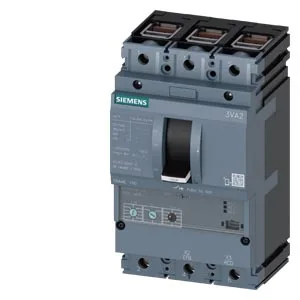
At 415 V it's 242 kA, and at 690 V it still holds 52.5 kA, so this breaker handles high-fault installations like transformer secondaries or large motor branch circuits where prospective fault current runs high. The overcurrent release is an ETU350M — a microprocessor-based trip unit with adjustable thermal-magnetic curves, phase-failure detection, and a voltage-trigger input. The shunt trip (STL) release is built in, so remote tripping from a safety PLC or emergency-stop chain is wired directly, no add-on module needed. Auxiliary contacts: two form-C auxiliary switches plus one dedicated trip-alarm switch (HQ), letting the control system distinguish a normal open from a fault trip.
Deployment context — panel integration and derating
At 63 A continuous the breaker dissipates up to 75 W, so internal panel temperature rise matters — the rating holds at 63 A up to 50 °C ambient, then derates to 60.48 A at 55 °C and 56.7 A at 70 °C. If the enclosure runs hot from drives or transformers, size the feeder for the derated current, not the 63 A nameplate.
What ships inside — internal sub-assemblies
The basic switch (the main contact and arc-chamber assembly) is order code 3VA2163-7MN36-0AA0, and the integrated auxiliary trip module is 3VA9688-0BL30. These are the serviceable sub-assemblies if the breaker takes a fault hit and needs internal replacement rather than full swap-out.