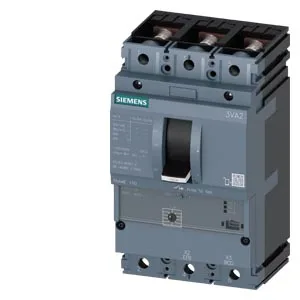
The 3-pole construction and 330 kA interrupting rating at 240 V (242 kA at 415 V) make it suitable for high-fault installations where upstream coordination is critical.
The interrupting ratings drop as voltage rises: 330 kA at 240 V, 242 kA at 415/440 V, 187 kA at 500 V, and 3.7 kA at 690 V. That steep fall at 690 V is typical for a 63 A frame — the arc energy at that voltage limits the interrupt capability. For a 480 V panel (common in North America), the 242 kA rating at 440 V is the closest benchmark; the actual 480 V value is not listed, but the curve suggests it sits between the 440 V and 500 V figures. Plan your series rating and let-through coordination around the 415 V column if your system is 480/277 V.
Auxiliaries and release — what ships on this variant
No ground-fault monitoring or communication module is fitted — that is the -0AA0 base variant's limitation. If you need GF or fieldbus feedback, this is not the variant; you step up to a -7MS32 with those options.
If you are retrofitting into a panel originally built around a 3VA2116-5HL32-0AK0 (a 16 A, 3-pole MCCB), the width and height are identical; the depth may differ slightly, but the mounting hole pattern and busbar connection points are the same across the 3VA2 frame family. No rewiring needed for a like-for-like swap.