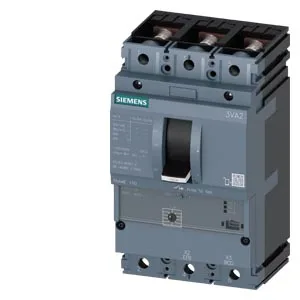
SENTRON 3VA2163-7MS32-0CL0 — 63 A MCCB with starter protection and UVR
The Siemens SENTRON 3VA2163-7MS32-0CL0 is a 3-pole molded case circuit breaker (MCCB) rated at 63 A continuously across the full 40 °C to 70 °C ambient range — no derating needed as the panel warms up. Its 330 kA breaking capacity at 240 V AC handles high-fault utility feeds; the rating steps down to 242 kA at 415/440 V and 187 kA at 500 V, with a sharp drop to 3.7 kA at 690 V, so confirm the available fault current at your service voltage. This MCCB is designed for starter protection — it integrates directly into motor starter assemblies, combining short-circuit and overload protection in one compact footprint.
The 3-pole configuration suits three-phase motor loads, and the 6.5 W maximum power loss is low enough to keep panel heat rise manageable in a dense lineup. Breaking capacity spans 330 kA at 240 V down to 3.7 kA at 690 V. At typical 400 V class distribution voltages (415/440 V) it interrupts 242 kA — sufficient for most industrial service entrances with high transformer capacity. The 690 V figure of 3.7 kA is a secondary winding rating; this breaker is not intended for primary 690 V high-fault applications.
The trip indicator provides local visual confirmation of a fault event, aiding rapid troubleshooting on the line.