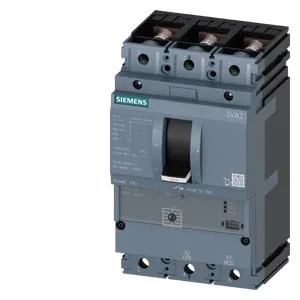
MCCB for high-fault panels
Breaking capacity across voltages
This MCCB delivers 242 kA at both 415 V and 440 V, 187 kA at 500 V, and 52.5 kA at 690 V. That voltage-dependent curve is typical of current-limiting MCCBs — the arc energy scales with voltage, so the interrupting rating drops. For a 480 V panel (common in North America), the 187 kA figure still covers most utility transformer secondary faults. At 690 V, the 52.5 kA rating suits industrial loads like large motors or VFD input feeders where fault current is lower.
Thermal derating and ambient limits
Above that, it derates: 60.48 A at 55 °C, 59.22 A at 60 °C, 57.96 A at 65 °C, and 56.7 A at 70 °C.
Starter protection version
This is the starter protection variant, meaning it's designed to coordinate with a contactor for motor starting duty. It includes a voltage trigger and the ETU310M release, but lacks an undervoltage release, auxiliary contacts, phase failure detection, ground fault monitoring, or communication functions. The mechanical endurance is 20,000 cycles — adequate for motor starting applications where the breaker sees infrequent switching (the contactor handles daily starts).
The depth of 86 mm includes the case body; allow extra for wiring and the shunt trip coil protrusion. Mounting is via screw-clamp to a backplate or DIN rail adapter (not included).