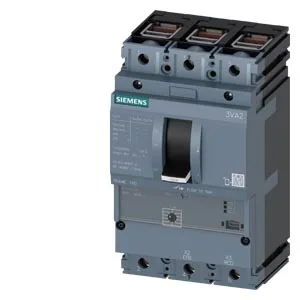
It's a 3-pole unit rated for a continuous 63 A across the full ambient range from 40°C to 70°C, so no derating headache when the panel sits near a kiln or a hot process line. The trip unit is adjustable between 189 A and 945 A, which covers motor inrush and locked-rotor conditions without nuisance tripping. At 240 V it interrupts 330 kA — that's a fault current level you'd see on a large service entrance or a high-capacity distribution board, not a light branch panel.
The breaker measures 105 mm wide, 181 mm tall, and 86 mm deep — a standard 3-pole MCCB footprint that drops into most DIN-rail or panel-mount arrangements without re-drilling. The 86 mm depth leaves room for rear-connected busbars or cable ladders behind the panel door. Operating temperature range is -25°C to 70°C, storage from -40°C to 80°C. That covers unheated warehouses and outdoor enclosures in most climates.
Interrupting ratings across voltages
The interrupting capacity drops as voltage rises: 330 kA at 240 V, 242 kA at 415 V and 440 V, 187 kA at 500 V, and 3.7 kA at 690 V. The steep drop at 690 V means this breaker is really a 500 V-class device for high-fault applications; at 690 V it's still adequate for most motor circuits but you'd want to confirm the available fault current at the point of installation.