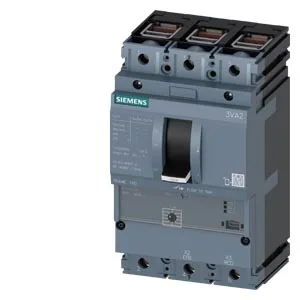
Three-pole, so it breaks all three phases on a three-phase motor circuit.
Interrupting capacity — what those numbers mean
This breaker's interrupting capacity is its headline spec: 330 kA at 240 V, 242 kA at 415 V and at 440 V, 187 kA at 500 V, and 3.7 kA at 690 V. For a 480 V panel in North America, you're looking at the 187 kA figure, which covers virtually any industrial service entrance or subfeed.
The 105 mm width per pole (35 mm per pole) is the standard MCCB footprint — it drops into a panel cutout or mounts on a mounting plate without special bracketry. Includes an undervoltage release as part of the auxiliary release set, which means it can be wired into a safety circuit that trips the breaker on loss of control voltage.
What the starter protection design buys you
Starter protection means the breaker's trip curve is coordinated for motor starting — it handles the 6–8x inrush without nuisance tripping, but still protects against locked-rotor and short-circuit conditions. The minimum setting is 189 A and maximum 945 A on the magnetic trip, which covers motor FLA from roughly 30 A to 150 A depending on the starter selection. No trip indicator and no voltage trigger — this is a straightforward thermal-magnetic breaker, not an electronic one. No communication function and no phase failure detection, so it's a pure protection device, not a monitoring one.
Environmental range and power loss
Maximum power loss is 6.5 W — negligible for panel heat calculations, but worth noting if you're tallying a dense cabinet. No ground-fault monitoring version — this is a straight MCCB, not a GFCI breaker.