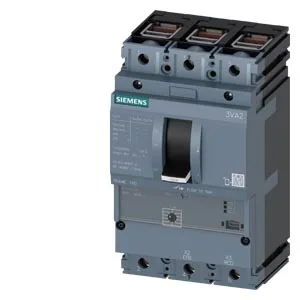
What this MCCB is and what the ratings mean for fit
The Siemens SENTRON 3VA2163-7MS36-0HC0 is a 3-pole molded case circuit breaker rated for 63 A continuous current, built as a starter protection version — meaning it is designed to sit ahead of a motor starter combination, providing both short-circuit and overload protection for the motor branch circuit. The 330 kA interrupting rating at 240 V tells you this breaker can safely clear a fault up to that level without upstream devices needing to coordinate; at 415 V and 440 V it still holds 242 kA, and at 690 V it drops to 52.5 kA. That kind of SCCR headroom is what you need when the available fault current at the panel is high — typical for large industrial switchboards or transformer-fed distribution. The ETU310M electronic overcurrent release gives you adjustable thermal and magnetic trip settings, which is the standard for coordinating with motor-start inrush without nuisance tripping. No undervoltage release, no ground-fault monitoring, no communication module — this is a straight motor-circuit protector with a shunt trip (STL) and two HQ auxiliary switches for status feedback to the PLC or safety relay.
Sourcing and lifecycle posture
Pricing and availability are confirmed at quote time against an RFQ. Because this is a current-production Siemens part, lead times typically follow the standard factory cycle; a sourcing inquiry will return the current delivery window and per-unit pricing for the quantity you need.
Panel integration and dimensions
At 105 mm wide, 181 mm tall, and 86 mm deep, this MCCB fits a standard SENTRON 3VA mounting footprint — it bolts directly to the panel backplate or onto a DIN-rail adapter plate. The 75 W maximum power loss at full load means you need to account for heat dissipation in the enclosure; if you are packing multiple breakers in a sealed cabinet, derate the ambient or add forced ventilation above 50 °C, where the continuous current starts to taper from 63 A down to 56.7 A at 70 °C. The operating temperature range is -25 °C to 70 °C, with storage from -40 °C to 80 °C. The 20 000 latching endurance cycles cover the mechanical life; for the electrical endurance, that depends on the breaking current at your service voltage — the datasheet's curve applies.
