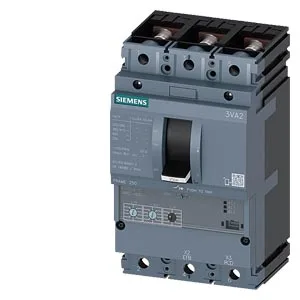
The ETU320 gives you adjustable thermal and magnetic protection curves, which is what you want when the load isn't a simple resistive heater but a motor or a distribution feeder where coordination matters. Breaking capacity runs from 187 kA at 240 V down to 5.1 kA at 690 V. At 415 V you're looking at 121 kA — that's a serious fault-current rating for a 160 A frame. The 690 V figure (5.1 kA) tells you this isn't a 690 V workhorse; it lives in the 240–500 V range where the interrupting numbers are high enough to handle most industrial service-entrance or feeder positions.
Rated 160 A at 40 °C, 45 °C, and 50 °C — no derating needed up to 50 °C ambient. At 55 °C it drops to 154 A, at 60 °C to 148 A, at 65 °C to 142 A, and at 70 °C to 136 A. That's a clean, linear curve: about 1.2 A per degree above 50 °C. If your panel hits 60 °C on a summer afternoon, you're still carrying 148 A continuous without nuisance tripping.
Auxiliary contacts and undervoltage release — what's inside the cover
That's enough for a status feedback loop to a PLC — one NO/NC for breaker position, one for the alarm contact on trip. The undervoltage release (UVR) is built in; it's the 3VA9608-0BB24 module. If your safety circuit drops control voltage, the UVR opens the breaker.
Width 105 mm, height 181 mm, depth 86 mm.
Power dissipation — panel thermal budget
Maximum power loss is 22.2 W at rated current. For a single breaker in a 600 x 400 mm panel it's negligible; stack four of these in a row and you're looking at 90 W of continuous heat — factor that into your ventilation or forced-air calculation.