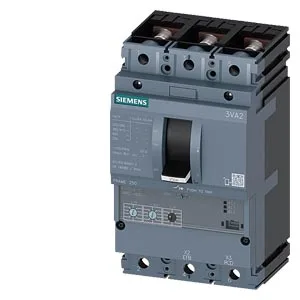
The Siemens SENTRON 3VA2216-5HL32-0JC0 is a 3-pole molded case circuit breaker (MCCB) rated for line protection, carrying 160 A continuous current at 40 °C through 50 °C, then derating to 136 A at 70 °C. At 415 V and 440 V it still holds 121 kA, dropping to 79 kA at 500 V and 5.1 kA at 690 V. The overcurrent release is an ETU320 — an electronic trip unit that provides LI (long-time and short-time) protection with adjustable settings, not just a fixed thermal-magnetic curve. That matters when coordinating downstream breakers in a selective distribution panel: you can set the short-time pickup and delay to let a branch breaker clear a fault before this main trips. The shunt trip (STL) integrated into the base switch allows remote tripping from an emergency-stop circuit or a PLC output, and the two HQ auxiliary switches report the breaker position back to the control system. Maximum power dissipation is 19.7 W, which should be factored into the enclosure thermal budget if the breaker is enclosed with other heat sources.
The 105 mm width occupies three 35 mm module spaces on the rail. The shunt trip and auxiliary switches are pre-wired to the base switch; no additional wiring is needed for the trip coil beyond connecting the control voltage.