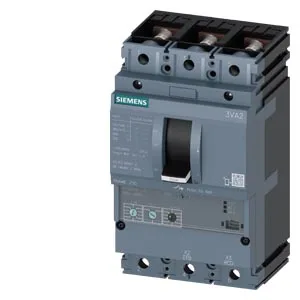
Three poles, no communication function, and no ground fault monitoring — this is a straight motor-feeder breaker with phase failure detection and an undervoltage release (UVR) built in. The 187 kA breaking capacity at 240 V AC drops to 121 kA at 415 V and 440 V, then to 75.6 kA at 500 V and 17 kA at 690 V — so the SCCR headroom at common distribution voltages (400/415 V) is still substantial for most industrial motor branch circuits. Thermal derating starts at 55 °C: the breaker carries 160 A continuously from 40 °C through 50 °C, then steps down to 153.6 A at 55 °C, 150.4 A at 60 °C, 147.2 A at 65 °C, and 144 A at 70 °C. That curve matters if this breaker lives inside a hot panel near drives or transformers — you lose about 10 % of the ampacity by 70 °C.
Trip unit, auxiliaries, and release configuration
The ETU350M electronic overcurrent release handles motor protection curves. Phase failure detection is standard — the trip unit responds to a lost phase, which is the most common cause of single-phasing motor damage. A mechanical trip indicator gives visual confirmation of a trip event. The undervoltage release (UVR) is factory-fitted as an integrated auxiliary trip (: 3VA9608-0BB11). Maximum power loss is 75 W — account for that in the enclosure thermal budget. That is typical for a 160 A frame MCCB in motor-switching duty — not a daily-switch application, but fine for infrequent isolation and fault clearing.
Depth of 86 mm includes the case body; add clearance for the rotary handle and cable lugs. Panel cutout and mounting pattern match the 3VA2 family, so a panel already laid out for a 3VA2 160 A frame accepts this unit without re-drilling.