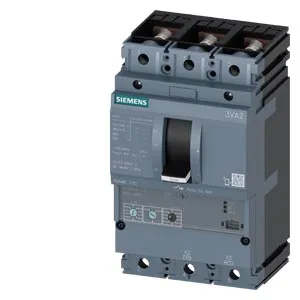
What this MCCB is and what it protects
The Siemens 3VA2216-5MN32-0DL0 is a SENTRON molded case circuit breaker (MCCB) designed specifically for motor protection — meaning its trip curve is shaped to handle the inrush of a motor starting while still clearing a locked-rotor or phase-failure fault before the winding insulation gives out. Rated 160 A continuously across the full ambient range from 40 °C to 70 °C, so no derating headache when the panel runs hot. Three-pole construction, 181 mm tall, 105 mm wide, 86 mm deep — fits standard MCCB mounting footprints in distribution boards and motor control centers.
Breaking capacity — what it clears and where
Breaking capacity is the real gate for panel coordination. At 415 V this MCCB interrupts 121 kA symmetrical — that's high enough for most industrial service-entrance and sub-distribution applications without needing a current-limiting fuse upstream. At 240 V it's rated 187 kA; at 500 V it drops to 75.6 kA; at 690 V it's 4.5 kA. The 415 V figure is the one to size against for standard 400 V class motor circuits. The short-time withstand and trip indicator help with selective coordination studies.
Integrated protection and signaling
This unit ships with an undervoltage release (UVR) built in — the design-of-auxiliary-release field confirms it. That means a loss of control voltage drops the breaker open, which is standard for safety circuits on conveyors or pumps where an unexpected restart after a power dip is unacceptable. The auxiliary switch configuration includes two auxiliary switches plus one trip alarm switch plus one electrical alarm switch HQ, giving four separate signal paths back to the PLC or status panel. Phase failure detection is also integrated, so a lost phase on the line side trips the breaker rather than letting the motor single-phase and overheat.
