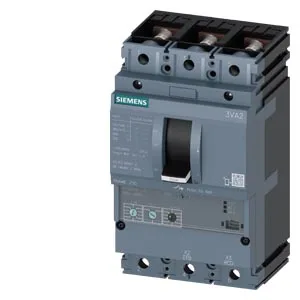
What it is and what it does
The Siemens SENTRON 3VA2216-5MN32-0JA0 is a 3-pole molded case circuit breaker (MCCB) rated for motor protection duty. It carries a flat 160 A rating across the full operating temperature range from 40 °C to 70 °C — no derating curve to chase as the panel warms up. Breaking capacity sits at 187 kA at 240 V, dropping to 121 kA at 415 V and 440 V, 75.6 kA at 500 V, and 4.5 kA at 690 V. That 187 kA figure at 240 V means it can interrupt very high fault currents typical on the secondary side of large distribution transformers — useful for service-entrance or main-tie applications where available fault current is high.
Key ratings and what they mean for fit
The 160 A rating is stable at 40 °C, 45 °C, 50 °C, 55 °C, 60 °C, 65 °C, and 70 °C — no reduction as ambient rises. That simplifies panel thermal budgeting: if your load draws 160 A, this breaker holds it regardless of enclosure heat buildup up to 70 °C. Trip time is adjustable between 4 s minimum and 17 s maximum — that range covers motor starting inrush without nuisance tripping while still clearing a sustained overload within safe thermal limits for the motor winding insulation class. Phase failure detection is built in, which is critical for motor protection — a single-phased motor draws locked-rotor current on the remaining phases, and this breaker will trip before the winding burns. The auxiliary release is a shunt trip (STL), allowing remote tripping via a control signal — useful for emergency-stop circuits or interlocking with upstream safety relays.
Physical fit and panel integration
Dimensions are 181 mm tall, 105 mm wide, and 86 mm deep. The 105 mm width is the standard 3-pole MCCB footprint for this class — it fits the same DIN-rail or mounting-plate cutout as other SENTRON 3VA molded-case breakers. Check the gland-plate clearance: 86 mm depth leaves room for rear-connected busbars or cable lugs in a standard 200 mm deep enclosure. Maximum power loss is 19.7 W. In a sealed panel with multiple breakers, that heat adds up — account for it in the enclosure's thermal dissipation calculation to avoid exceeding the 70 °C operating maximum.
